Showing posts with label biodiversity. Show all posts

Thursday, January 17, 2013

Last week in the studio


Preparing for an Exhibition in Paddington next month has been keeping me busy. Percolator Gallery, where I will be showing, faces out onto a lively boutique and second-hand shopping precinct on a hillside close to the heart of the city. Even better... its in the same building where my studio is located so logistics are very doable. Consequently I've felt very positive about managing the other things on my calendar at this time which I mentioned in the last post... relocating my home.


The postcard I designed and ordered today as an invitation to the
upcoming show. All the details are on the back
. More info here.


In 2011 I made a postcard for an event I was evolved in in Brisbane and the concept of Bio-cultural-diversity seemed to just pop into my mind then and there. Obviously I had absorbed it somewhere along the line.


Every time I glanced at that postcard afterwards I'd think more deeply about the concept. By the end of last year it was becoming  a significant influence on my aesthetic, the general direction in my art practice and my research. I started to write about it and reconsider our place in the world according to age-old practices across time and place.

Gravitating towards print-making once again since the Cairns Residency I've re-examined tendencies in my work over years and noted that it was around 2005 when I'd started working with collaged fabric on canvas fro painting on, and using the selvedge,  stitching and textural features from time to time.
I started working on calico cloth as well as canvas back then and a while later painting on linen. I've painted on cloth since I was at school way back when I immersed myself in batik for a few years ... heavily influenced by having studied Indonesian in Language at School.

I've mused on deep attachments I've had to certain fabrics I've owned, bought at op-shops or elsewhere, having been given or inherited. I had a mother who sewed and was known to find uses for pieces from  my collection. My cherished pieces were left alone though and it occurred to me they are virtually the most durable of things I own, having moved so often Ive been able to see what's lasted through considerable change...and more rightly... what I've managed to pack and bring with. Textiles pack well... and my stash has stood the test of time better then most other possessions.


This fabric I couldn't bear to part with despite its eventual worn-out state. I took these photos at the wonderful Dorothy Caldwell Workshop 'Human Marks' in May last year. Dorothy's art practice celebrated the life of garments and fabrics and much was made from old as well as new materials.
I was overjoyed to have a place to take this once perfect item made from superb Italian seersucker. They'd been made for me years before from fabric I'd found at a wholesalers. Beautifully designed fabric... it had been so light and cool to wear I really missed them in my wardrobe. 


I remember packing for my 2008 move interstate to Brisbane and giving many precious pieces from my kitchen to a few good friends because, not long out of hospital, I was beyond trying to pack prized tea cups and all. What did come with me were the fabrics that have always made wherever I live feel like home. 

An important piece from years ago, a lino-printed and painted table cloth that my mother made with my help in Melbourne 20+ years ago when she was down on holidays takes pride of place on the family table all these years later.

It has such history now... so many dinner parties and events ... it really is of huge significance to her ... and to me. The lino squares featured in that cloth came from my teaching days in the 1980's... reminding me of the extraordinary remote coastal place I lived when those squares were cut. There is an octopus lino-cut inspired by an Ancient Greek ceramic vessel from 3,000 yrs ago. The cloth's design was made up of so many pieces of history... complex and storied. 23 years  later I wanted to make revisit that idea and make another cloth to imbue with story. 

So this is what I was working on in the studio last week...

Working on a linen-cotton piece of fabric 200 cm x 140 cm ...with the idea in mind to create a cloth to be hung, not stretched! Exploring Bio-cultural-diversity across cultures, time and landscape of late got me thinking about Tapa cloths in particular.

In Queensland one sees these cloths wherever Pacific island people are represented. In Cairns I felt so much more a part of the Pacific ... the presence of island people is very strong there.

Reading about Tapa cloths online tonight I found these notes from the Kew Gardens Economic-Botany Collections:

Bark Cloth

The Economic Botany Collections at Kew house around 40 specimens of bark cloth, a versatile material made from beaten tree bark, once used widely in the Pacific Islands and Indonesia . Bark cloth comes primarily from trees of the Moraceae family, including Broussonetia papyrifera, Artocarpus altilis, and Ficus spp. It is made by beating strips of the fibrous inner bark of these trees into sheets, which are then finished into a variety of items.
The main use of bark cloth is for clothing. The Collections at Kew illustrate the amazing ability of this beaten tree bark to form soft and delicate items of apparel. Examples include shawls, loincloths, headdresses, skirts, dresses, shirts, and even a tight fitting jacket. 
Bark cloth has not just been worn, however, but has also been used as a wrapping for the deceased, a dowry, a room partition, and a mosquito screen. The cloth has played an important role in the societies of the South Pacific, being incorporated into folklore, religion, culture, and ritual. It has been popular in ritual gift exchange, in everyday trading and in healing ceremonies, and it has been used to symbolise status and wealth, with the level of decoration, the style of wearing, and the amount of cloth worn signifying rank.
 In Tahiti , for example, the upper class wore the รข€˜ahutara' or shawl over their shoulders, while the lower classes wore one rectangle tucked around the body and under the arms so the shoulders were exposed to passing superiors. Meanwhile, in Fiji the length of a man's loincloth symbolised his rank. A chief's loincloth would drag on the ground, while a poor man's loincloth would drape over his belt as little as possible.
Each region in the Pacific developed its own unique methods of production, style of wearing and design. The Economic Botany Collections at Kew have examples from a wide geographical range, including Pitcairn, Hawaii, Tahiti, the Cook Islands, Samoa, Futuna, Tonga, Fiji, the Solomon Islands, Sulawesi, Halamahera, Seram, New Guinea, and Java. The samples cover the many diverse uses, designs and styles of bark cloth, and are the result of a number of private collectors and colonial expeditions in the 19th century, from HRH the Duke of Edinburgh to the mutineers of the HMS Bounty. Most of the examples at Kew date from the late 19th century. The production of bark cloth slowed considerably in the 20th century, eventually dying out in all but a few islands as missionaries from the west visited the Pacific, bringing with them western ideas and goods such as cotton textiles. In fact, it became a sign of a convert to wear cotton, rather than bark cloth.
With the manufacture of bark cloth in such decline, the Collections at Kew serve as an important reminder of this unique craft. The specimens kept here will provide present and future generations with a chance to see samples of the beautifully crafted cloth, and an opportunity to learn about the societies who once used bark cloth in nearly every aspect of their lives, from clothing their children and adorning their priests to healing their sick 


The part that interests me at this time is the way the Tapa cloth was incorporated into folklore, religion, culture, and ritual ... and with this feeling of the value of ritual, cultural practice and remembering I  worked on the 'Homage to the seed' cloth last week late into the nights.


Building up layers slowly by creating a foundation using square lino tiles that I've been using for 26 years now. There is a personal history held in the marks the old lino-squares make... coupled here with recent lino cut motifs. 


I like to merge the organic with the more geometric... working in a painterly manner ...leaving space and adding dots which always to my mind are seeds ...especially after times spent in the seed lab counting tiny seeds... dots as seeds. 


The lino-prints are worked with in this painterly way to allow for a raw and natural aesthetic... also reflected in mono-printing with recycled polystyrene trays... a quick way to do series of stripes and some of the dots. 
Interestingly much of the Islander work may not feature a 'raw' aesthetic, but, rather favour extremely precise and masterful line-work, cutting, printing and painting techniques. A Thursday Island artist I met in Cairns described the high level of competition in his community (amongst males) to draw well and produce prints that were extremely fine works.


An area of the cloth that feels like a painting within a painting. Seed-capsule circular cross sections are shown on the right. My objective is not to emulate in any way cloths that one might see... but to focus instead on making something that holds stories for me and that may communicate something of the continuous thread of nature... the eternal cycles and rhythms.


In the workspace the cloth was so large I kept turning it around ...using a table I could move as needed.


Getting closer to completion... working flat on a table where one's vision is not an overall one make balancing the composition and colours a little harder. There is a desire to retain some of the raw first layer and to allow the fabric to show through... it is a painting... yet its not quite how I usually go about painting. On a stretcher frame there is more freedom to overpaint, or take out an area thats not working or adjust colours and so on.


I like to walk away from work nearing completion so I can get some perspective.
This work will be in my Exhibition coming up next month at Percolator Gallery... so it will be interesting working out how it should be hung... and seeing whats needed for it to feel complete. A bit of finessing to get the compositional balance I like yet. 

My next cloth is almost completed now. I went with a simple composition for that one... lots of raw fabric showing through. 
I look forward to putting these up to see them properly.


I've posted The making of a 'Homage to the seed' cloth (9 photos) on my Homage to the Seed page on Facebook  so if you wish to follow the Homage to the seed page visit (above) and click on like! 

Welcome to those new to this blog and I wish all a most productive week!

Sunday, December 2, 2012

five minute post: from the Daintree


... its been a preference of mine to take time and post something I've been musing on... but since realising I have neglected loads of images gathered here and there plus also started to seriously neglect posting at all.... maybe this brief post is a strategy worth adopting.

I hope to do the longer version... but i wanted to share these snaps from a walk in the magnificent Daintree World Heritage listed rain forests of Nth Qld in the region where I was located for a month... see Sept-Oct posts!


ciao,
S

Friday, June 17, 2011

two things to share with you!

Bloggers...  for all of you ...artists, designers, makers, gardeners, carers, world-makers, thinkers ...
all of you who love the authentic... the precious... the gift of time plus hearts and minds put to good purposes...


Chloe proudly showing her drawing!

Firstly....
biocultural heritage diagram

This graphic is about protecting the interlinked systems of Biocultural heritage...
                 
                       What I hear you ask?

Well thats the whole thing... all of us...  every living thing on this planet.... every language, cultural tradition, blade of grass and more.

And no... life is always changing and we cant keep things still... but we do need to understand the links and act now to preserve a great deal of what is passing.


Revered Goddess via Ghost Colours tumblr


Secondly... I'll share this thought with you from indigenous people of Chile:

"The seeds are our mothers because they nurture us. Sometimes they become our babies, and they need our protection, care and warmth. In other moments they are our sisters, with whom we enjoy, sing and dance. That's how we are all family in our Andean world."


please visit the homage blog where you can read more on this and leave a comment today if you will....

Sophie x
    and a good weekend to you all!


Friday, June 3, 2011

You're invited to this weekend's event for World Environment Day ...and by the way...where did this week go?


Burning the midnight oil ... got completely engrossed in painting late yesterday afternoon and put in a very long session when really there had been other plans. Oh well! No photos of that yet.

Instead here's a couple of snaps from the saturday workshop up the coast. 14 of us in all..  it went far too quickly. Maybe the need to get some paint on canvas yesterday same from being in such a beautiful area over the weekend (see previous post) ... and this wonderful class who turned up with the most fantastic finds from the bush and coast-line near where they all live. We managed to fit in slow time for close observation drawings and then some much more experimental painterly work on paper... where was I with my camera for that?


Tonight Ive been going through notes and material on seeds and biodiversity for the weekend event I'm doing... I found poems and quotes I'd saved, basically everything I needed and more. I liked the lines from the piece below:

         "each latent cell puts out a future,
                  unfolds its differing complexity..."


sustainability_green.jpg


If you are in Brisbane on Saturday then come along... I put all the details about the program here for you to read and you can go to the Hillbrook website to see the program, list of stall, speakers and entertainment. There's a fabulous recycling set-up for computer gear, bikes, clothing... you name it.


Sutainability Day falls on the weekend of World Environment Day celebrations which I posted on here at this blog and here at the Homage blog recently. The UN titled this year's WED theme " Nature at your service" and the year is dedicated to forests... so as a tribute to trees I'll include these thoughts.


loved this tree I photographed at the Wellington Botanic Gardens  in New Zealand.
Its on my screensaver'... along with other travel photos and everytime it
comes up on the large screen I have to stop and gaze!


Enjoy your weekend everyone... I'll not be around for a few days really!
S

Saturday, May 14, 2011

So what's your favourite Tree?


The other night I posted at the Homage blog on the upcoming World Environment Day (June 5th) pages at the United Nations Environment Program website. THe Tree of the Day page in particular caught my eye. NB: Image and text below from this site.


So what has a tree done for me lately?

AUSTRALIA

Eucalypt


The Eucalypt tree is traditionally an Aborigine folk remedy, used in Australian natural medicine. Today, the Eucalypt is used worldwide in pharmaceutical products such as pills, liquids, inhalers, salves, ointments and even in sweets.
It helps relieve symptoms of colds, flu, chest congestion, sore throats, bronchitis and much more.
Next time you stock up your drug cupboard, make sure that you’ve planted a couple of Eucalypt trees for future supplies!


As its the United Nations International Year of the Forest and the June 5th WED theme this year is "Forests: nature at your Service" I wanted to ask you what are your favourite trees and why?

I went through my photos and found these from last year...


at the Botanic Gardens at Mt Cot-Tha last year


The Black Palm - Normanbya Normanbyi - is a single stemmed, large-seeded palm endemic to the Cape Tribulation region of North Queensland. Pinkish fruit - around 280 ripe fruit per tree (according to one source) which ripen over 21 weeks and seeds are dispersed mainly by water flow, cassowaries and small mammals. During my walk last week I came across the amazing sight of these fruit fallen from high up the tree all over the ground surrounding the base of the tree.


This photo comes without notes to prompt my memory... loved these blooms!

Below is a series of images I took when visiting the Royal Botanic Gardens at Cranbourne, an hour south-east of the city of Melbourne, in December last year. 

The Royal Botanic Gardens Cranbourne is one of Victoria's most precious areas of native bushland and offers nature-lovers the chance to explore 363 hectares of untouched heathlands, wetlands and woodlands. These expansive natural gardens are also home to thriving bird and animal life, including several rare endangered species.

Click on these below to see the various walks you can do there:


I really liked this Diversity garden below. 85 bio-regions from across the continent were represented in this unusual format... plants arranged in rows according to regions making identification
simple and differences easily observable. Light rain was falling for the first hour (chilly for a December day) but my friends and I had a wonderful few hours exploring. With a friend from South Australia, a Melbourne friend and myself from Qld we had an interesting time looking at regional diversity.


Diversity garden

Australia’s landscape is diverse, both in look and botanically, and yet historically, European Australians have tended to characterise the land as empty rather than full. This garden aims to dispel this myth. The Diversity Garden is an abstract journey through the 85 bio-regions of Australia.


The photos I took of these trees below are of Tree Grasses -  Xanthorrhoea johnsonii - the tallest of which is thought to be about 400 years old. From what I understand its a protected species and is generally found in northern NSW into Qld. These trees were a common sight in my childhood on the North Coast of NSW... hour long car-trips to the beach through bushland with these dotted all around hold vivid and very fond memories. 


The Cranbourne Gardens are relatively new... established in the early 80's but far more recently opened to the public.... so much of this Botanic Garden  is in development. What makes it exciting is that it is completely planted out with indigenous species and brings an excellent focus to understanding this heritage - past, present and future concerns.
Comparing the image above and below of the same species highlights the museum-like quality of a garden compared to natural habitat. However, without these 'museums' many would never see or think about species of trees and plants... and so they play a vital role...and increasingly so. This species is itself under threat.


by contrast...in situ - Atherton Tablelands, Qld


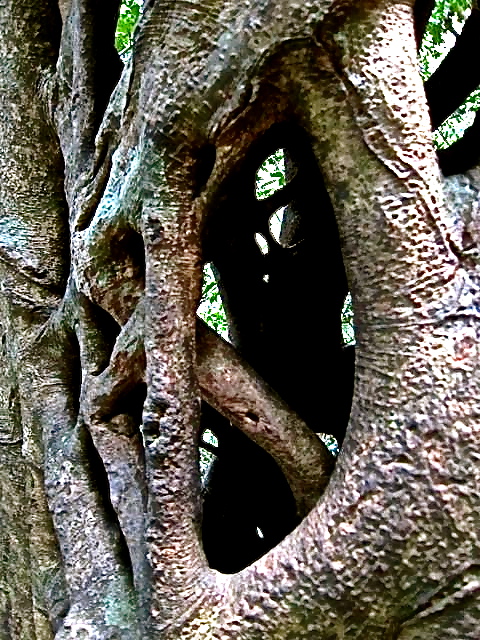
close up of the textured trunk of this tree.


loved the moss growing on this one


So... the question is... what is you favourite tree?.If you want to email an image and text I'll make  up a post by WED, 5th of June. Or if you have a drawing or painting of a tree perhaps.  If I go back through journals from over the years there's quite a few tree drawings to be found. Ive never painted trees but often enjoyed drawing them.


image: City of Nedlands, Western Australia


image: my green australia


Have a great weekend everyone... and hope you remember to notice the trees! 
Sophie 

Thursday, March 3, 2011

when we move in who moves out?

.... inspiration comes from many directions for artists.... visit homage to the seed blog to read about a local Brisbane-based artist who has been exploring biodiversity on canvas.


the artist's bush retreat!

As for the post title... a visit to the other blog will reveal more!
cheers!
S

Monday, January 24, 2011

shredding oranges... but can we grow them?


I got the blues
thinking of the future,
so I left off and
made some marmalade.
Its amazing how
it cheers one up
to shred oranges
and scrub the floor
D H Lawrence
(from Sophie Munns’ journal)


uncertaintimes:

Hollie Chastain


uncertaintimes:

Mandrake (Mandragora officinarum), from Tacuinum Sanitatis (15th c.)


uncertaintimes:

Festival of Sekhtet, Nakhtโ€™s tomb


paradisexpress:

japaneseflowergarden:

simplyadreamer:

(via laboomeria)
paradisexpress:
People have been cultivating plants for a very long time... 
certainly thousands of years... so long as there was somewhere to
plant seeds... or propagate a plant ...then people have been growing 
plants for all manner of purposes....for all kinds of sustenance.

I just read a story that made me wonder what kind of arrogance and 
idiocy would drive a government to sign a bill to make it illegal
to grow food in one's own back yard? A bill that would outlaw 
gardening and saving seeds!
Please take a few minutes to read 
this post that I put up at the 
homage blog 10 minutes ago. Sorry 
to be bossy about this... but if 
you enjoy your art, your lovely 
home and fine food ... then think for 
a few minutes about the consequences
of a bill like this... and what 
happens when it is picked up in 
another country and another!
Some things should not be put off!
What do you think?


update from last night:
Thank you to all who communicated, sent links 
and emailed to participate in an important dialogue..


And thanks to bloggers who went the extra mile and tracked down 
links to put perspective onto this issue which has collected energy
as it has been disseminated out into the ether. Like the proverbial 
chinese whispers in some cases the story was changed beyond 
recognition
However should you care to read the Bill: 
The Federal Food, Drug, and Cosmetic Act with respect to the safety of the food supply 
the link was sent in by 2 bloggers... in summary form from Sharmon 
of true adventures of an art addict and in full from Egmont of 
the artist within us to the homage blog.
It was well put by Sharmon:
I was extremely alarmed by what I read in your email, so I did a bit of research. For the most part, it seems to be an 
internet hoax, thank goodness. The bill exists, but most of the claims made by Natural News are false. According to 
snopes, which is usually very reliable,(http://www.snopes.com/politics/business/organic.asp), the bill contains nothing 
about home gardeners, seeds, or organic farms. I read a summary of the bill at govtrack.us (http://www.govtrack.us/
congress/bill.xpd?bill=s111-510&tab=summary), and that appears to be true. 
However, the Farm to Consumer Legal Defense Fund (http://www.ftcldf.org/news/news-02mar2009.htm) sees it as 
over-regulation which will put an undue burden on small family farms. Thanks for bringing it to may attention; I will 
research it further. But believe me, if I thought the bill would effect our right to grow gardens or save seeds (both 
of which I do and intend to continue), I'd be picketing on the front steps of the Capital Building.


This comment answered some of the questions at the top of the my
list ... however it must be noted that there is quite a difference 
in reading the summary as opposed to the complete Bill sent in by 
Egmont...I suspect many trying to read this bill would find themselves 
wondering anxiously if they might be missing something! 


What struck me most about this entire story after it came to my 
attention yesterday was that we're poised to expect bad news from 
the transationals gobbling up control of global food markets. Many 
of us have taken on board the fact that it is indeed illegal in 
some parts of the world to grow food from seeds saved locally, 
according to traditions extending back generation upon generation. 
Food sovereignty is a huge issue. 
The fear accompanying this story I picked up yesterday is not coming 
for no reason. And if we, for even a moment, thought about what 
it might feel like to lose our food sovereignty we can be present 
to the issue that is already out there for some...
as a chronically harsh reality served up because there was no power
to intervene... or perhaps understanding to see the need to!


elastica:

(via thiswillhurt)
posted at seed capsules

This image from the previous post is quite apt for this discussion. 
There's huge fear surrounding peak oil, peak water and peak food...
 population growth and climate change. Some put their head in the 
sand and say its not happening, its not coming!
Others are sponges and seem to soak up all the information and ideas
that are circulating and of course this can be too much!
We can easily be overloaded like we were here in the recent floods
that many are still dealing with. In our vulnerability we often
recognize the suffering of others... so the challenge to stay on 
the one hand open and receptive and on the other not overwhelmed 
and fearful. 
To 'Replace fear of the unknown with curiosity' is a bold act 
because it suggests venturing up to meet what's coming rather than 
hiding... but with a willingness to discover/uncover new ways 
to partipate in the challenges and possibilities of our time!


Lets keep the dialogue happening... sharing knowledge is vital
in this time of increasing velocity and complexity of change. I 
really appreciate everyone coming by and taking a moment to 
reflect, add something, walk away even with new resolve to watch 
what'happening more closely.
Go well,
S x