Preparing for an Exhibition in Paddington next month has been keeping me busy. Percolator Gallery, where I will be showing, faces out onto a lively boutique and second-hand shopping precinct on a hillside close to the heart of the city. Even better... its in the same building where my studio is located so logistics are very doable. Consequently I've felt very positive about managing the other things on my calendar at this time which I mentioned in the last post... relocating my home.
 |
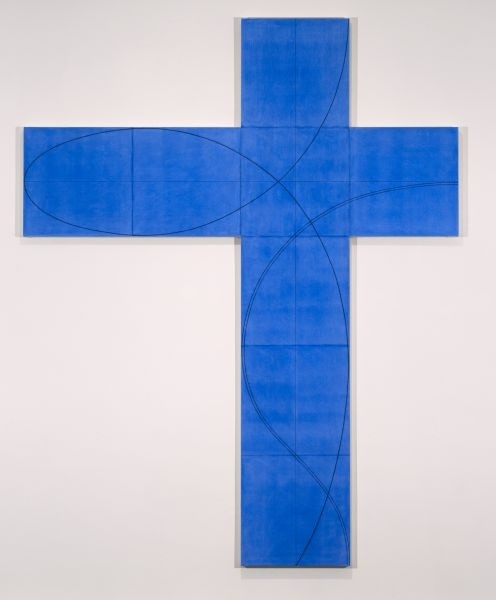
The postcard I designed and ordered today as an invitation to the
upcoming show. All the details are on the back. More info here. |
In 2011 I made a postcard for an event I was evolved in in Brisbane and the concept of Bio-cultural-diversity seemed to just pop into my mind then and there. Obviously I had absorbed it somewhere along the line.
Every time I glanced at that postcard afterwards I'd think more deeply about the concept. By the end of last year it was becoming a significant influence on my aesthetic, the general direction in my art practice and my research. I started to write about it and reconsider our place in the world according to age-old practices across time and place.
Gravitating towards print-making once again since the Cairns Residency I've re-examined tendencies in my work over years and noted that it was around 2005 when I'd started working with collaged fabric on canvas fro painting on, and using the selvedge, stitching and textural features from time to time.
I started working on calico cloth as well as canvas back then and a while later painting on linen. I've painted on cloth since I was at school way back when I immersed myself in batik for a few years ... heavily influenced by having studied Indonesian in Language at School.
I've mused on deep attachments I've had to certain fabrics I've owned, bought at op-shops or elsewhere, having been given or inherited. I had a mother who sewed and was known to find uses for pieces from my collection. My cherished pieces were left alone though and it occurred to me they are virtually the most durable of things I own, having moved so often Ive been able to see what's lasted through considerable change...and more rightly... what I've managed to pack and bring with. Textiles pack well... and my stash has stood the test of time better then most other possessions.
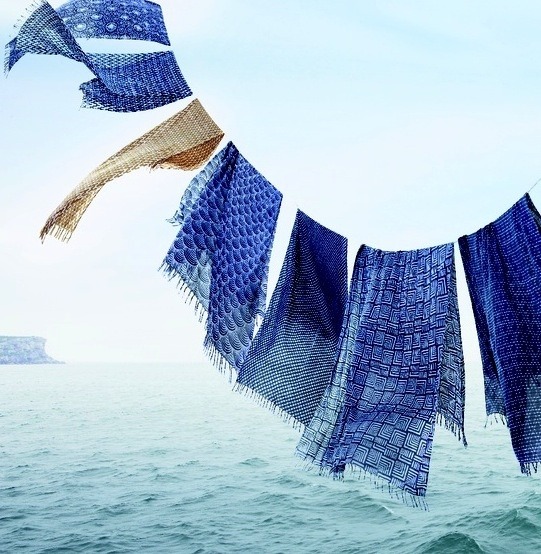
This fabric I couldn't bear to part with despite its eventual worn-out state. I took these photos at the wonderful Dorothy Caldwell Workshop 'Human Marks' in May last year. Dorothy's art practice celebrated the life of garments and fabrics and much was made from old as well as new materials.
I was overjoyed to have a place to take this once perfect item made from superb Italian seersucker. They'd been made for me years before from fabric I'd found at a wholesalers. Beautifully designed fabric... it had been so light and cool to wear I really missed them in my wardrobe.
I remember packing for my 2008 move interstate to Brisbane and giving many precious pieces from my kitchen to a few good friends because, not long out of hospital, I was beyond trying to pack prized tea cups and all. What did come with me were the fabrics that have always made wherever I live feel like home.
An important piece from years ago, a lino-printed and painted table cloth that my mother made with my help in Melbourne 20+ years ago when she was down on holidays takes pride of place on the family table all these years later.
It has such history now... so many dinner parties and events ... it really is of huge significance to her ... and to me. The lino squares featured in that cloth came from my teaching days in the 1980's... reminding me of the extraordinary remote coastal place I lived when those squares were cut. There is an octopus lino-cut inspired by an Ancient Greek ceramic vessel from 3,000 yrs ago. The cloth's design was made up of so many pieces of history... complex and storied. 23 years later I wanted to make revisit that idea and make another cloth to imbue with story.
So this is what I was working on in the studio last week...
Working on a linen-cotton piece of fabric 200 cm x 140 cm ...with the idea in mind to create a cloth to be hung, not stretched! Exploring Bio-cultural-diversity across cultures, time and landscape of late got me thinking about Tapa cloths in particular.
In Queensland one sees these cloths wherever Pacific island people are represented. In Cairns I felt so much more a part of the Pacific ... the presence of island people is very strong there.
Reading about Tapa cloths online tonight I found these notes from the Kew Gardens Economic-Botany Collections:
Bark Cloth
The Economic Botany Collections at Kew house around 40 specimens of bark cloth, a versatile material made from beaten tree bark, once used widely in the Pacific Islands and Indonesia . Bark cloth comes primarily from trees of the Moraceae family, including Broussonetia papyrifera, Artocarpus altilis, and Ficus spp. It is made by beating strips of the fibrous inner bark of these trees into sheets, which are then finished into a variety of items.
The main use of bark cloth is for clothing. The Collections at Kew illustrate the amazing ability of this beaten tree bark to form soft and delicate items of apparel. Examples include shawls, loincloths, headdresses, skirts, dresses, shirts, and even a tight fitting jacket.
Bark cloth has not just been worn, however, but has also been used as a wrapping for the deceased, a dowry, a room partition, and a mosquito screen. The cloth has played an important role in the societies of the South Pacific, being incorporated into folklore, religion, culture, and ritual. It has been popular in ritual gift exchange, in everyday trading and in healing ceremonies, and it has been used to symbolise status and wealth, with the level of decoration, the style of wearing, and the amount of cloth worn signifying rank.
In Tahiti , for example, the upper class wore the ‘ahutara' or shawl over their shoulders, while the lower classes wore one rectangle tucked around the body and under the arms so the shoulders were exposed to passing superiors. Meanwhile, in Fiji the length of a man's loincloth symbolised his rank. A chief's loincloth would drag on the ground, while a poor man's loincloth would drape over his belt as little as possible.
Each region in the Pacific developed its own unique methods of production, style of wearing and design. The Economic Botany Collections at Kew have examples from a wide geographical range, including Pitcairn, Hawaii, Tahiti, the Cook Islands, Samoa, Futuna, Tonga, Fiji, the Solomon Islands, Sulawesi, Halamahera, Seram, New Guinea, and Java. The samples cover the many diverse uses, designs and styles of bark cloth, and are the result of a number of private collectors and colonial expeditions in the 19th century, from HRH the Duke of Edinburgh to the mutineers of the HMS Bounty. Most of the examples at Kew date from the late 19th century. The production of bark cloth slowed considerably in the 20th century, eventually dying out in all but a few islands as missionaries from the west visited the Pacific, bringing with them western ideas and goods such as cotton textiles. In fact, it became a sign of a convert to wear cotton, rather than bark cloth.
With the manufacture of bark cloth in such decline, the Collections at Kew serve as an important reminder of this unique craft. The specimens kept here will provide present and future generations with a chance to see samples of the beautifully crafted cloth, and an opportunity to learn about the societies who once used bark cloth in nearly every aspect of their lives, from clothing their children and adorning their priests to healing their sick
The part that interests me at this time is the way the Tapa cloth was incorporated into folklore, religion, culture, and ritual ... and with this feeling of the value of ritual, cultural practice and remembering I worked on the 'Homage to the seed' cloth last week late into the nights.
Building up layers slowly by creating a foundation using square lino tiles that I've been using for 26 years now. There is a personal history held in the marks the old lino-squares make... coupled here with recent lino cut motifs.
I like to merge the organic with the more geometric... working in a painterly manner ...leaving space and adding dots which always to my mind are seeds ...especially after times spent in the seed lab counting tiny seeds... dots as seeds.
The lino-prints are worked with in this painterly way to allow for a raw and natural aesthetic... also reflected in mono-printing with recycled polystyrene trays... a quick way to do series of stripes and some of the dots.
Interestingly much of the Islander work may not feature a 'raw' aesthetic, but, rather favour extremely precise and masterful line-work, cutting, printing and painting techniques. A Thursday Island artist I met in Cairns described the high level of competition in his community (amongst males) to draw well and produce prints that were extremely fine works.
An area of the cloth that feels like a painting within a painting. Seed-capsule circular cross sections are shown on the right. My objective is not to emulate in any way cloths that one might see... but to focus instead on making something that holds stories for me and that may communicate something of the continuous thread of nature... the eternal cycles and rhythms.
In the workspace the cloth was so large I kept turning it around ...using a table I could move as needed.
Getting closer to completion... working flat on a table where one's vision is not an overall one make balancing the composition and colours a little harder. There is a desire to retain some of the raw first layer and to allow the fabric to show through... it is a painting... yet its not quite how I usually go about painting. On a stretcher frame there is more freedom to overpaint, or take out an area thats not working or adjust colours and so on.
I like to walk away from work nearing completion so I can get some perspective.
This work will be in my Exhibition coming up next month at Percolator Gallery... so it will be interesting working out how it should be hung... and seeing whats needed for it to feel complete. A bit of finessing to get the compositional balance I like yet.
My next cloth is almost completed now. I went with a simple composition for that one... lots of raw fabric showing through.
I look forward to putting these up to see them properly.
Welcome to those new to this blog and I wish all a most productive week!