Continued from Part One:
It was curious to find both Thursday night's GoMA Talks panel, in a cultural setting, and Friday/Saturday's seminar in a business context, focused so heavily on technology, media, trends, challenges and opportunities. I liked the symmetry of it... and both curiously added considerably to my understanding and receptivity to think more carefully about it.
Tonight over at tumblr I pondered the last few days... what I've been thinking about ... including this book from the library ... and Im reminded how extraordinary a time it is for the sphere of the mind.
I'll maybe add another post on a few bits from the Ferran Adria book which I have relished reading about - my budget doesn't typically run to such restaurants - nor have i been drawn to the fashion for this food... but I'm finding the story of his journey utterly fascinating... especially the parts about his studio... and a time when he moved into a sculptor's studio over a summer to collaborate and bounce off another set of ideas!
 |
| Ferran Adria |
Cross-pollination at its best - any chefs available for next summer at my studio?

|
Robert Mangold
“Ring Image C” 2010
152.4 x 152.4 cm
Acrylic and pencil on canvas |
At Tumblr I read something about the noosphere ... which got me thinking after a few days on the topic of www and such things...
In the original theory of
Vernadsky, the noosphere is the third in a succession of phases of development of the Earth, after the
geosphere (inanimate matter) and the
biosphere (biological life). Just as the emergence of life fundamentally transformed the geosphere, the emergence of human
cognition fundamentally transforms the biosphere. In contrast to the conceptions of the
Gaia theorists, or the promoters of
cyberspace, Vernadsky's noosphere emerges at the point where humankind, through the mastery of nuclear processes, begins to create resources through the
transmutation of elements. It is also currently being researched as part of the Princeton
Global Consciousness Project.
[6]
I'm not well-versed in this concept at all... but I do find it interesting to ponder. This is excerpted from Wiki...which as you know is not necessarily reliable ... however in this case I think it at least introduces leading ideas around this concept.
Teilhard de Chardin is often called the patron saint of the Internet - he was one who introduced the idea of the 'noosphere' into his writing 'Cosmogenesis' - he was a French philospher and Jesuit Priest (1881-1955)
...more on Noosphere from Wiki:
History of concept
For Teilhard, the noosphere emerges through and is constituted by the interaction of human minds. The noosphere has grown in step with the organization of the human mass in relation to itself as it populates the earth. As mankind organizes itself in more complex
social networks, the higher the noosphere will grow in awareness. This concept is an extension of Teilhard's
Law of Complexity/Consciousness, the law describing the nature of evolution in the universe. Teilhard argued the noosphere is growing towards an even greater integration and unification, culminating in the
Omega Point, which he saw as the goal of history. The goal of history, then, is an apex of thought/consciousness.
One of the original aspects of the noosphere concept deals with
evolution.
Henri Bergson, with his
L'évolution créatrice (1907), was one of the first to propose evolution is 'creative' and cannot necessarily be explained solely by Darwinian natural selection.
L'évolution créatrice is upheld, according to Bergson, by a constant
vital force which animates life and fundamentally connects mind and body, an idea opposing the dualism of
René Descartes. In 1923,
C. Lloyd Morgan took this work further, elaborating on an '
emergent evolution' which could explain increasing
complexity (including the evolution of mind). Morgan found many of the most interesting changes in living things have been largely discontinuous with past evolution, and therefore did not necessarily take place through a gradual process of natural selection. Rather, evolution experiences jumps in complexity (such as the emergence of a self-reflective universe, or noosphere). Finally, the complexification of human cultures, particularly language, facilitated a quickening of evolution in which cultural evolution occurs more rapidly than biological evolution. Recent understanding of human ecosystems and of human impact on the biosphere have led to a link between the notion of sustainability with the "co-evolution" [Norgaard, 1994] and harmonization of cultural and biological evolution.
The resulting political system has been referred to as a
noocracy.
American
integral theorist Ken Wilber deals with this third evolution of the noosphere. In his work,
Sex, Ecology, Spirituality (1995), he builds many of his arguments on the emergence of the noosphere and the continued emergence of further evolutionary structures.
The term
Noöcene epoch refers to "how we manage and adapt to the immense amount of knowledge we’ve created."
[1]
It is also the reason Teilhard is often called the patron saint of the Internet.[7]
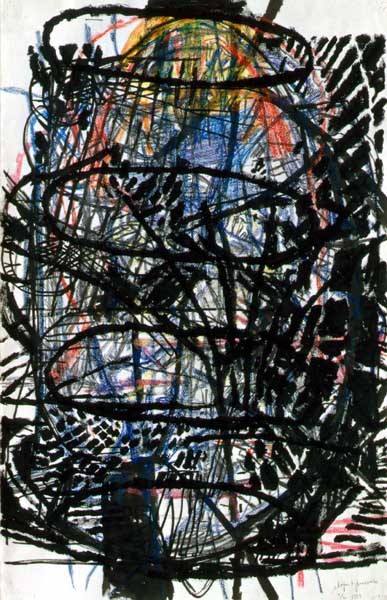 |
Terry Winters - shape and pressure 1999
|
I do think its useful to think about using the internet in multi-
dimensional ways ... business for me has to be aligned with
other layers of possibility ... and then it becomes more animated,
worthwhile, motivating ... even inspiring.
What do you think?
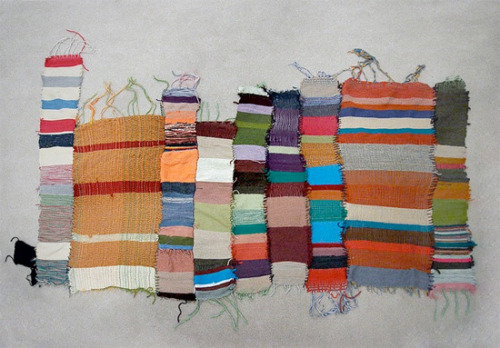
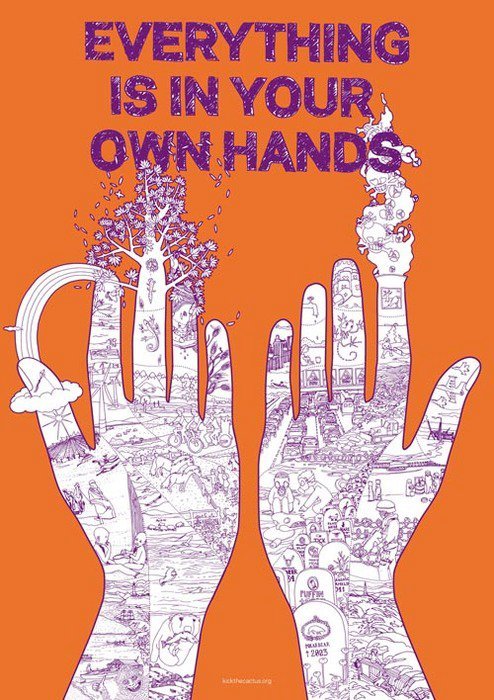
Ive put all this material over two posts to propose the idea of all things being connected ... this time being ripe for the weaving together of business and culture, Science and Art, Environmental sustainability with everything ... head, heart and hands!
Heres to all the weaving together, shaping and transforming that we need to get on with... I do think were in for a very busy time somehow!